Have you ever wondered why children often get rhinopharyngitis when using air conditioning?
And you yourself, why do you feel tired after a night in the air conditioner or exhausted after a day in the air conditioner. Air conditioners of all types simply circulate the air in your room and need to close the door to work effectively. Lack of fresh air or in other words lack of oxygen, excess CO2 and accumulation of pathogens weaken your body. To learn more, you can read the entire section below.
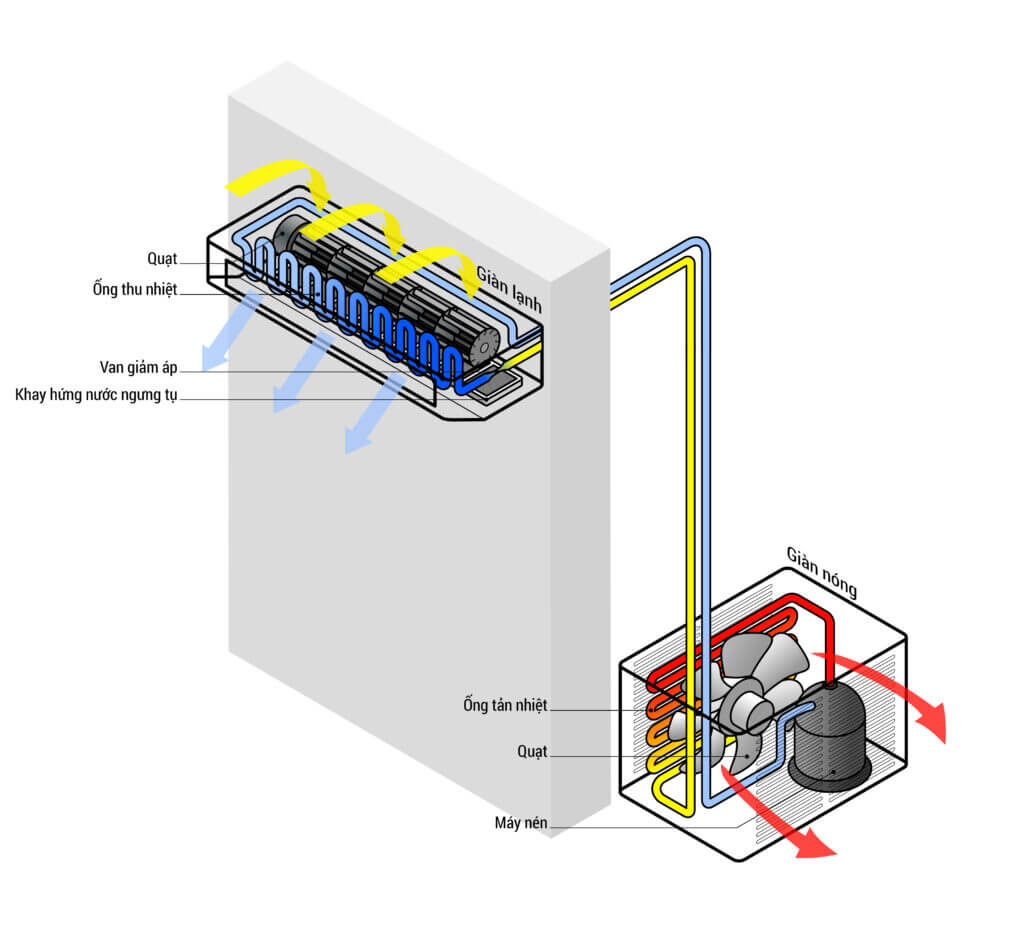
First, let’s find out how an air conditioner works. The picture below shows a typical air conditioner with two coils: a hot coil outside and a cold coil inside.
Connecting the two coils are two copper pipes that conduct the refrigerant with a small diameter, only about 1 cm, and are usually insulated. Together with the coils in the hot and cold coils, they form a closed loop for the refrigerant to move inside.
The refrigerant will take heat from the indoor evaporator to lower the temperature of the evaporator and then push this heat energy outside at the hot evaporator.
In order to spread the low temperature of the evaporator to other places in the house, the evaporator fan will draw air from the upper inlet (yellow arrow), blow it through the tubes containing the low surface temperature refrigerant to reduce it to the desired temperature before being pushed out through the door below the evaporator (light blue arrow).
So we can see the connection between the two coils of the air conditioner is just two solvent pipes, not air pipes. The air conditioner does not provide you with new air from outside, but simply circulates and cools the air trapped in the room.
In other words, when you use an air conditioner, you are locking yourself in a sealed box with a limited amount of oxygen. This is similar to putting a plastic bag over your head, except that the plastic bag is exactly as big as your room.
Central air conditioner, ceiling mounted, multi,…
So what about ceiling mounted air conditioners, central air conditioners, multi air conditioners or central air conditioners connected to the air duct? Yes, they all share the same principle as above: circulating air in the room through the cooling coil to adjust the room temperature. No air conditioner provides you with new air.
Above is a picture of a ceiling mounted air conditioner, the air is sucked in at the center to cool, then pushed out at 4 surrounding doors. The two black pipes at the back are two copper pipes that carry the refrigerant to the outdoor condenser and are covered with black insulation. As you can see here, the air is only circulating in the room between the doors of the machine. No new air enters your room.
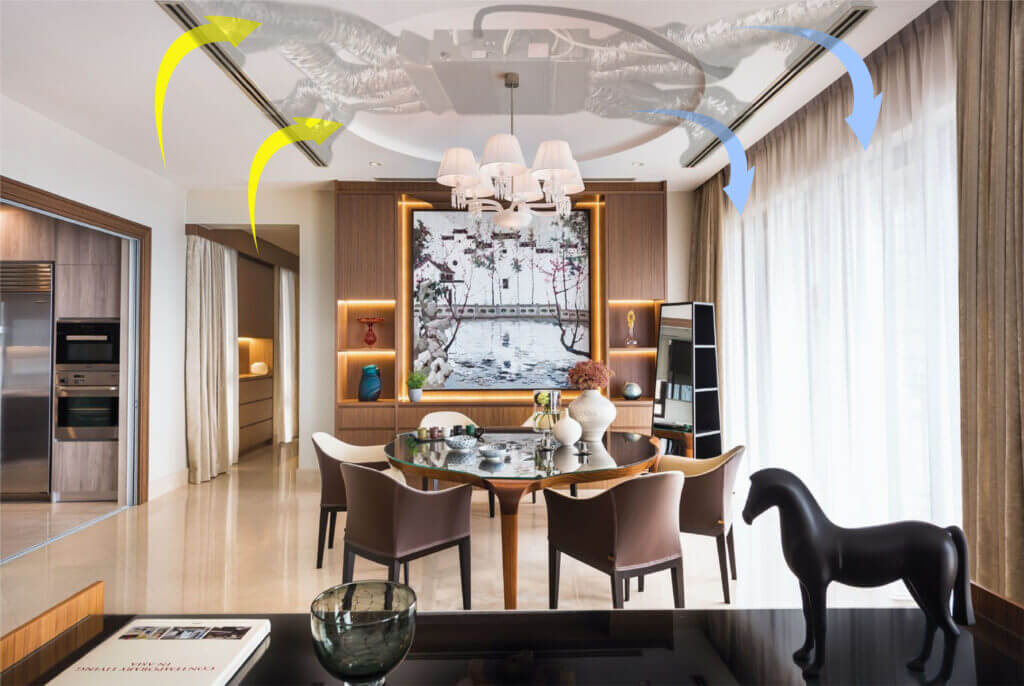
The picture below is the living room of a luxury apartment where the central air conditioning system connected to the duct alone can cost up to several hundred million. However, like most families using central air conditioning in Vietnam, the owner does not realize that the air conditioner simply sucks air in on one side (yellow arrow), cools it and then pushes it out on the other side (light blue arrow). The air in the house is often stagnant, lacking oxygen, with excess CO2, full of bad odors and very harmful to health.
Is fresh air important to you? Well, none of us like to stick our heads in a sealed plastic bag, right?